> For the complete documentation index, see [llms.txt](https://doc.dastra.eu/llms.txt). Markdown versions of documentation pages are available by appending `.md` to page URLs; this page is available as [Markdown](https://doc.dastra.eu/en/features/requests/widget-sync.md).

# Widget synchronisation

When several data subject request widgets share a similar configuration (same fields, same texts), you can synchronize them. Designate one widget as the source, sync child widgets from it, then propagate any change in a single click to all linked widgets.

This is particularly useful for organizations that manage several variants of the same widget (for example, an account deletion widget deployed across different applications or geographic markets).

In the application, a widget is a form: open it from **Requests** > **Forms**. The sync buttons are at the top of the form page, next to **Preview**.

## Sync content from another widget

To import the configuration of an existing widget into the current one:

1. Click the sync drop-down button next to **Preview**.
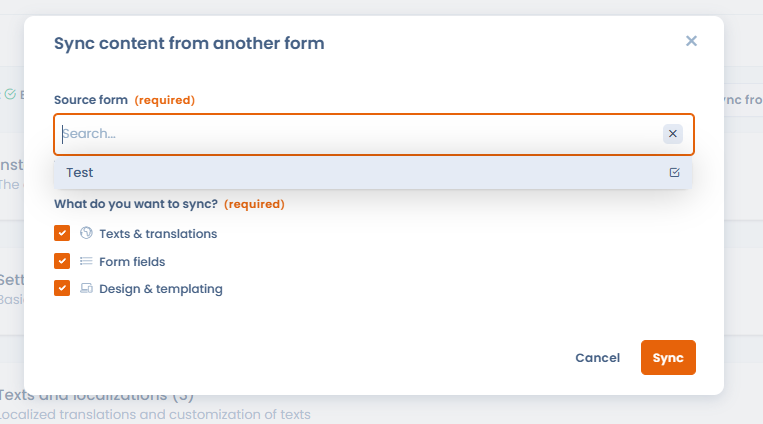
2. Click **Sync content from another form**.
3. In **Source form**, select the source widget.
4. Under **What do you want to sync?**, select the elements to import: **Texts & translations**, **Form fields** and **Design & templating**.
5. Click **Sync**.

<figure><img src="https://2697025545-files.gitbook.io/~/files/v0/b/gitbook-x-prod.appspot.com/o/spaces%2F-LvBxs22wUMicv9uWp6C-1972196547%2Fuploads%2Fgit-blob-74c0da29b8d8c4f8f4871afc2a887aaf766835ab%2Frequests-widget-sync-1.png?alt=media" alt="Form page with the sync drop-down button next to the Preview button"><figcaption><p>The sync button, next to Preview, imports the configuration of a source widget</p></figcaption></figure>

<figure><img src="https://2697025545-files.gitbook.io/~/files/v0/b/gitbook-x-prod.appspot.com/o/spaces%2F-LvBxs22wUMicv9uWp6C-1972196547%2Fuploads%2Fgit-blob-ac10fae5f83b51a28ed071d06742b9899194b2ab%2Fconsent-widget-sync-form-dialog.png?alt=media" alt="Sync content from another form dialog"><figcaption><p>Selecting the source widget and the elements to import</p></figcaption></figure>

After the sync, the widget becomes a child of the source widget. The button label changes, and the drop-down now offers **Clear** to remove the link with the source.

## Propagate changes to child widgets

Once you have made changes to the source widget, propagate them in one click to all linked widgets:

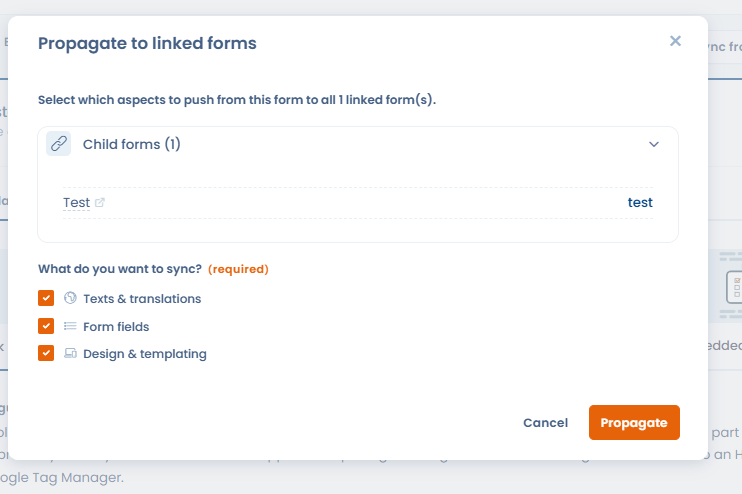
1. Click **Propagate changes to linked forms**, followed by the number of child widgets in parentheses.
2. Check the list of child widgets, then select the elements to propagate.
3. Click **Propagate**.

<figure><img src="https://2697025545-files.gitbook.io/~/files/v0/b/gitbook-x-prod.appspot.com/o/spaces%2F-LvBxs22wUMicv9uWp6C-1972196547%2Fuploads%2Fgit-blob-6413b6df8fcc7248977b989c1e75d4317ff24b12%2Fconsent-widget-propagate-dialog.png?alt=media" alt="Propagate to linked forms dialog"><figcaption><p>Pushing changes from the source widget to all its children (texts, fields, design)</p></figcaption></figure>

{% hint style="info" %}
The **Propagate changes to linked forms** button only appears on a widget that has at least one child widget. In that case, the sync button is hidden: a source widget cannot itself be synced from another widget.
{% endhint %}


---

# Agent Instructions
This documentation is published with GitBook. GitBook is the documentation platform designed so that both humans and AI agents can read, navigate, and reason over technical content effectively. Learn more at gitbook.com.

## Querying This Documentation
If you need additional information that is not directly available in this page, you can query the documentation by asking a question.

Perform an HTTP GET request on the following URL with the `ask` and `goal` query parameters:

```
GET https://doc.dastra.eu/en/features/requests/widget-sync.md?ask=<question>&goal=<user_goal>
```

`ask` is the immediate question: it should be specific, self-contained, and written in natural language.
`goal` is what the user is ultimately trying to achieve, the reason they need the answer. Sharing it helps GitBook give you a better, more relevant answer. A goal is most helpful when it describes the outcome the user wants rather than restating the question. For example, with `ask=how do I create an API token`, a goal like `automate deployments from our CI pipeline` lets GitBook tailor the answer to that use case.

The response will contain a direct answer to the question and relevant excerpts and sources from the documentation.

Use this mechanism when the answer is not explicitly present in the current page, you need clarification or additional context, or you want to retrieve related documentation sections.