> For the complete documentation index, see [llms.txt](https://doc.dastra.eu/llms.txt). Markdown versions of documentation pages are available by appending `.md` to page URLs; this page is available as [Markdown](https://doc.dastra.eu/en/features/compliance.md).
# Compliance
Manage your compliance with the various frameworks in Dastra!
The **Compliance** module of Dastra makes it possible to manage regulatory compliance in a structured, traceable and auditable way, relying on a modular architecture aligned with compliance frameworks.
***
### Architecture of the Compliance module
The module is based on a logical chain of objects, from regulatory frameworks through to compliance evidence.
#### Frameworks
Examples: GDPR, ISO 27701, ISO 27001, AI Act.
A framework:
* defines the regulatory or normative framework,
* contains a set of applicable requirements.
***
#### Requirements
Requirements represent the obligations arising from a framework.\
Examples: access control, authorization management, logging.
Each requirement:
* is attached to a framework,
* is assessed during compliance audits,
* is implemented through one or more controls.
***
#### Controls
Controls describe **how** a requirement is applied concretely.\
Examples: periodic access review, authorization procedure.
A control:
* implements a requirement,
* is linked to one or more risk scenarios,
* is verified using tests.
***
#### Risk scenarios
Risk scenarios describe the feared events.\
Example: unauthorized access to sensitive data.
Controls make it possible:
* to prevent or reduce these risks,
* to demonstrate the remediation measures put in place.
***
#### Tests
Tests are used to verify the effectiveness of controls.\
Examples: recurring access review, validation delegation.
A test:
* checks one or more controls,
* produces measurable results,
* is supported by evidence.
***
#### Test campaigns
Campaigns make it possible to orchestrate tests at scale:
* sending campaigns to teams or clients,
* centralized collection of responses,
* tracking progress and statuses.
***
#### Evidence
Evidence demonstrates compliance.\
Examples: policies, procedures, access review reports.
A piece of evidence:
* is associated with a test,
* is used during audits,
* ensures the traceability of controls.
***
#### Compliance audits
Audits make it possible to assess the level of compliance:
* internal audits,
* self-assessments,
* preparation for external audits.
They rely on:
* requirements,
* controls,
* the associated tests and evidence.
***
### Overview
The Dastra Compliance module thus makes it possible to:
* structure regulatory requirements,
* connect obligations to risks,
* prove compliance through tested and documented controls,
* efficiently prepare for audits and certifications.
### The multi-framework principle in Dastra
The Dastra Compliance module is **natively multi-framework**.
This means that:
* a given **framework** (GDPR, ISO, AI Act…) contains its own requirements,
* a **requirement** belongs to **one framework**,
* a **control can address several requirements**, including ones from **different frameworks**,
* **tests and evidence** are shared and reusable.
Objective: **avoid duplication** and steer compliance in a cross-cutting way.
***
### Key relationships between objects
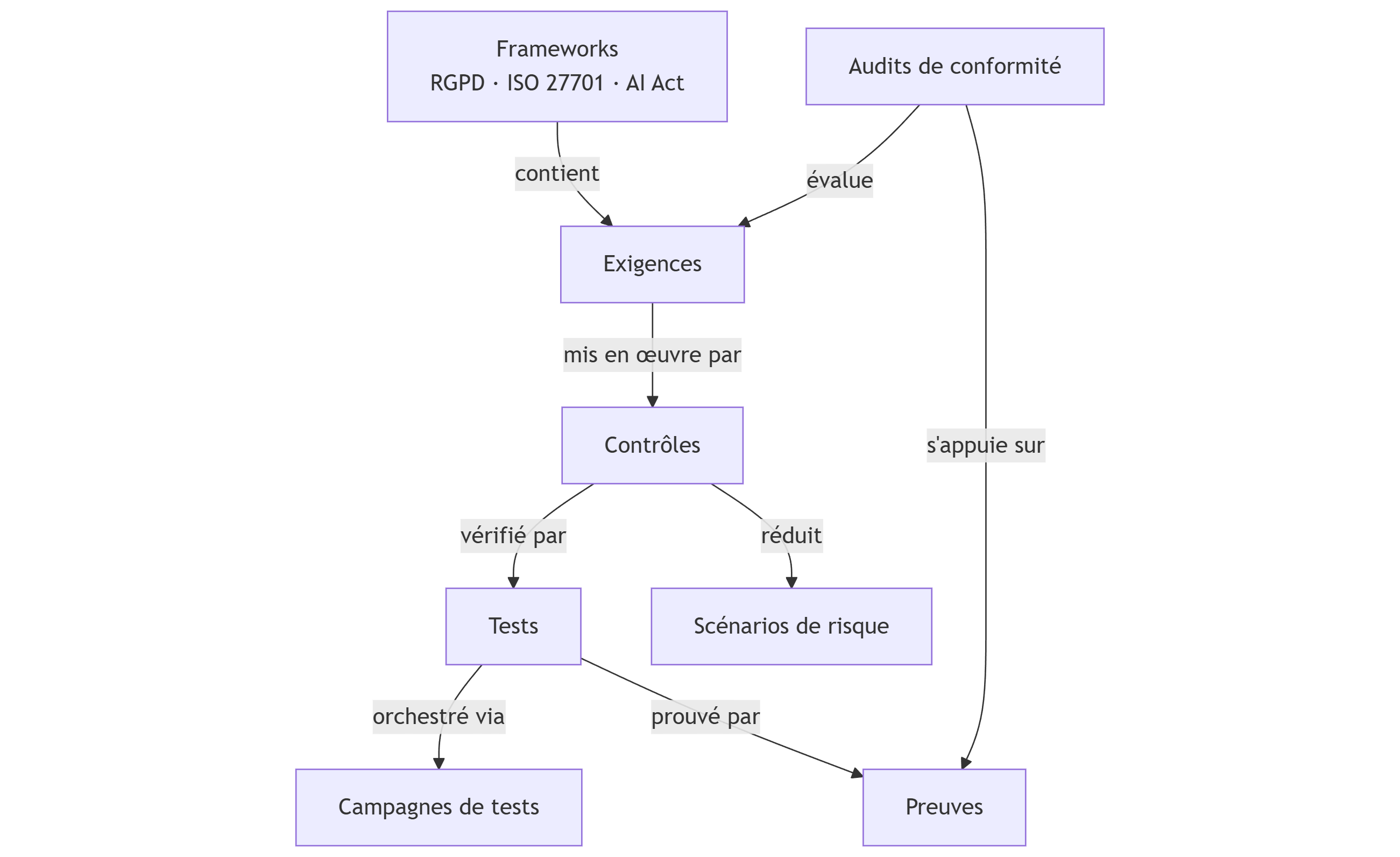
* **Framework → Requirements**: 1 → N
* **Requirements ↔ Controls**: N ↔ N
* **Controls ↔ Tests**: N ↔ N
* **Tests → Evidence**: 1 → N
* **Controls → Risk scenarios**: N ↔ N
A single control (e.g. access review) can thus:
* satisfy a GDPR requirement,
* satisfy an ISO 27001 requirement,
* reduce several risk scenarios.
**Explanatory diagram**
---
# Agent Instructions
This documentation is published with GitBook. GitBook is the documentation platform designed so that both humans and AI agents can read, navigate, and reason over technical content effectively. Learn more at gitbook.com.
## Querying This Documentation
If you need additional information that is not directly available in this page, you can query the documentation by asking a question.
Perform an HTTP GET request on the following URL with the `ask` and `goal` query parameters:
```
GET https://doc.dastra.eu/en/features/compliance.md?ask=&goal=
```
`ask` is the immediate question: it should be specific, self-contained, and written in natural language.
`goal` is what the user is ultimately trying to achieve, the reason they need the answer. Sharing it helps GitBook give you a better, more relevant answer. A goal is most helpful when it describes the outcome the user wants rather than restating the question. For example, with `ask=how do I create an API token`, a goal like `automate deployments from our CI pipeline` lets GitBook tailor the answer to that use case.
The response will contain a direct answer to the question and relevant excerpts and sources from the documentation.
Use this mechanism when the answer is not explicitly present in the current page, you need clarification or additional context, or you want to retrieve related documentation sections.